
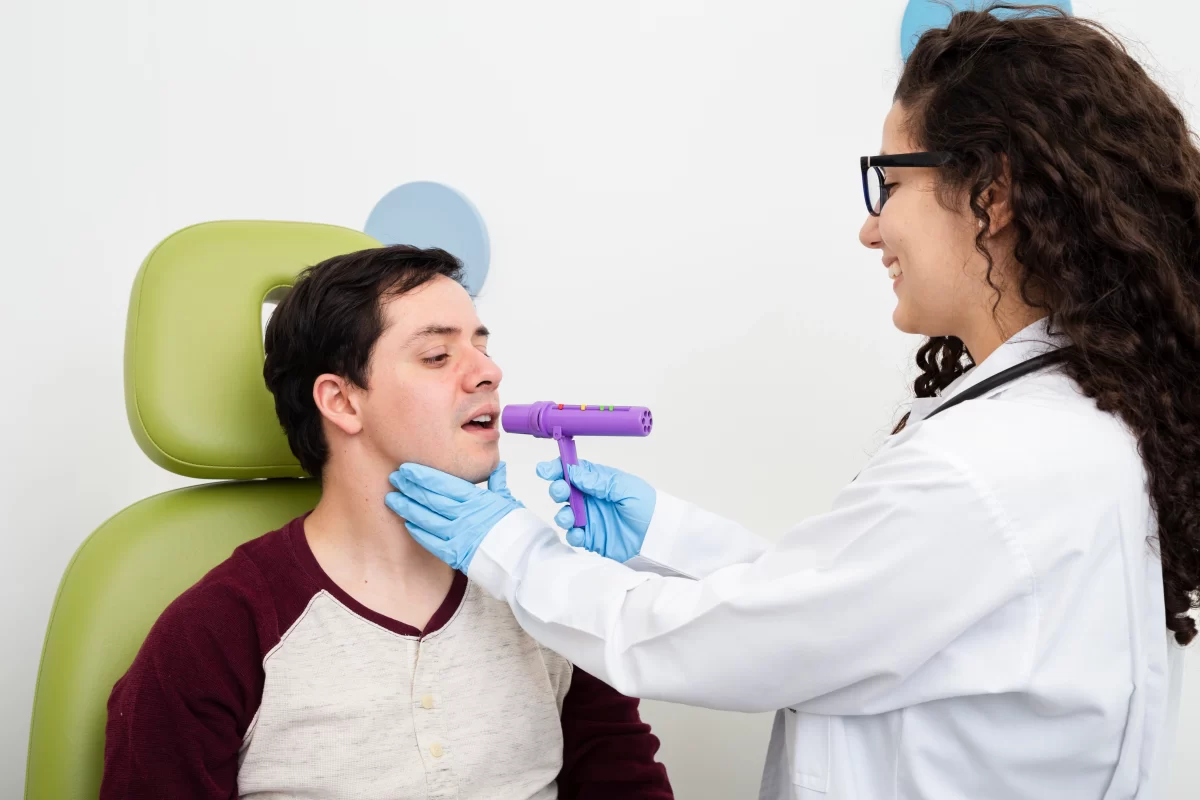
Experiencing frequent nasal blockage, recurring sinus infections, nosebleeds, or difficulty breathing through your nose? Your ENT specialist may recommend a test called Diagnostic Nasal Endoscopy (DNE) to examine the inside of your nasal passages.
DNE in ENT is a diagnostic procedure that allows a specialist to view areas inside the nose using a thin instrument with a camera and light. It helps identify possible causes of nasal symptoms and supports decisions about further tests or treatment.
But what exactly happens during a DNE test? Is it painful, how should you prepare, and are there any risks? Here is what you should know before undergoing the procedure.
What Is DNE in ENT (Diagnostic Nasal Endoscopy)?
DNE, or Diagnostic Nasal Endoscopy, is an examination performed by an ENT specialist to look inside the nose and nasopharynx (the back of the nose) using a narrow endoscope with a light and camera. The image appears on a monitor, so you and the doctor can see the findings together.
A basic nose examination with a speculum only shows the front of the nasal cavity. DNE reaches the deeper areas, including the middle meatus, where the sinuses drain. These are the areas where most chronic nose and sinus problems begin.
Two types of scopes are used:
- Rigid endoscope (0° or 30°): Gives the sharpest image and is commonly used in ENT clinics
- Flexible endoscope: A bendable, softer scope that is more comfortable for sensitive patients and for children
Why Is Diagnostic Nasal Endoscopy Done?
DNE is done when nose or sinus symptoms cannot be explained by a basic examination alone.
Common indications include:
- Nasal blockage that has not improved with medicines
- Chronic or recurrent sinusitis
- Frequent nosebleeds (epistaxis)
- Loss or reduction of smell
- Constant post-nasal drip or a constant feeling of mucus in the throat
- Facial pain or heaviness that suggests sinus disease
- Recurrent ear problems linked to the back of the nose, such as glue ear
- Planning for sinus surgery, or reviewing the nose after surgery
Uses of DNE: What Can It Show?
DNE gives your ENT specialist a direct view of structures that cannot be seen from outside.
| Area Examined | What DNE Can Detect |
| Nasal septum | Deviation, spurs, perforation |
| Turbinates | Swelling or enlargement causing blockage |
| Middle meatus and sinus openings | Blocked drainage, pus, polyps |
| Nasal lining | Allergy changes, inflammation, crusting, bleeding points |
| Nasopharynx | Enlarged adenoids, masses, Eustachian tube openings |
| Growths | Nasal polyps, cysts, tumours (which may be biopsied) |
| Foreign objects | Items lodged in the nose, especially in children |
| After surgery | Healing, scarring, and recurrence of polyps |
How to Prepare for Diagnostic Nasal Endoscopy
DNE is one of the easiest ENT tests to prepare for, but a few simple steps make the examination smoother, safer, and more accurate.
- No fasting needed: You can eat and drink normally before the test
- Share your medicines: Tell your doctor if you take blood thinners such as aspirin or warfarin, as they can increase the chance of a nosebleed
- Mention allergies: Let the doctor know about any allergy to local anaesthetics or nasal sprays so a safe alternative can be used
- Carry previous reports: Bring earlier CT scans, X-rays, and ENT notes so unnecessary repeat tests can be avoided
- Skip nasal sprays beforehand: Avoid decongestant or steroid sprays just before the test unless your doctor advises otherwise
- Report pregnancy or bleeding problems: Tell the doctor if you are pregnant, have a bleeding disorder, or have had a recent nosebleed or nasal surgery
Procedure of DNE (Diagnostic Nasal Endoscopy)
DNE is done in the ENT clinic and usually takes 5-10 minutes.
Step 1: Positioning. You sit upright or semi-reclined in a chair.
Step 2: Decongestion and numbing. A spray or soaked cotton pledget containing a decongestant and a local anaesthetic (such as lignocaine) is placed in the nose for a few minutes. This shrinks the lining and numbs the area.
Step 3: Inserting the scope. The endoscope is gently passed along the floor of the nose and then along the middle of the nose, step by step.
Step 4: Examination. The doctor examines the septum, turbinates, sinus drainage areas, and the nasopharynx on the screen. You may be asked to breathe gently through your nose.
Step 5: Documentation. Images or video are saved for your records. If needed, a small tissue sample can be taken.
Step 6: Discussion. Findings are explained immediately, and a treatment plan or further tests, such as a CT scan, are suggested if needed.
Is DNE painful? Most people feel pressure, a tickling sensation, or an urge to sneeze, rather than pain. General anaesthesia is not needed for DNE in adults. Children who cannot cooperate may need special handling.
5 Major Benefits of DNE (Diagnostic Nasal Endoscopy)
Benefit 1: Direct, High-Definition View
DNE lets the ENT specialist see the deeper nasal anatomy clearly, so the diagnosis is based on what is actually inside your nose instead of guesswork from symptoms alone.
- Shows areas a simple nasal speculum cannot reach, such as the middle meatus and nasopharynx
- Magnified images make small polyps, crusts, or bleeding points easy to spot
- Findings appear on a screen, so you can see the problem and understand it too
Benefit 2: Quick Diagnosis in One Visit
The examination takes only a few minutes, and in most cases you leave the clinic with a clear answer and a treatment plan, without waiting days for results.
- Often replaces weeks of trial-and-error treatment with medicines
- Helps your doctor decide immediately whether a CT scan or biopsy is needed
- Saves repeat visits, time off work, and consultation costs
Benefit 3: No Cuts, No Hospital Stay
DNE is a non-surgical outpatient test, so there is no incision, no general anaesthesia in adults, and no downtime afterwards.
- Done in the ENT clinic with only a local numbing spray
- You can usually drive, eat, and return to work the same day
- A comfortable option for anxious patients and older adults
Benefit 4: Better Treatment Decisions
Finding the exact cause, such as polyps, a blocked sinus opening, a deviated septum, or enlarged adenoids, means treatment is targeted, whether that is medicine or surgery.
- Helps avoid unnecessary repeated antibiotics for sinus symptoms
- Confirms whether surgery such as FESS or septoplasty is truly needed
- Allows a small tissue sample to be taken from suspicious areas for timely diagnosis
Benefit 5: Safe and Repeatable
DNE uses no radiation, so it can be repeated as often as needed to track how a condition is responding to treatment.
- Useful for monitoring nasal polyps and chronic sinusitis over time
- Checks healing and detects recurrence after nasal or sinus surgery
- Safe to use in children and in most adults, with a flexible scope for sensitive patients
What Are the Complications of DNE?
DNE is a very safe procedure, and serious complications are rare. Most side effects are mild, short-lived, and settle without treatment.
- Mild discomfort or sneezing: Pressure, tickling, or an urge to sneeze is common and usually stops once the scope is removed
- Minor nosebleed: More likely if you take blood thinners or have a fragile nasal lining, and it usually stops within minutes with gentle pressure
- Light-headedness or fainting: A vasovagal reaction can happen in anxious patients, so you may be asked to stay seated for a few minutes afterwards
- Watery eyes or throat numbness: Caused by the anaesthetic spray, and both fade within an hour
- Allergic reaction to the anaesthetic spray: Rare, but tell the doctor beforehand if you have a known allergy
- Minor mucosal injury: Rare, and almost always heals by itself
Tell your doctor in advance if you have a bleeding disorder or take blood thinners, and contact them if you notice heavy or repeated bleeding after the test.
Recovery After DNE
Recovery after DNE is immediate for most patients, since the test is brief and needs no sedation in adults. Any irritation is short-lived and settles without treatment.
- Resume normal daily activities: You can usually return to work, driving, and daily routines straight away
- Wait before eating or drinking: Avoid food and fluids for 30-60 minutes while your throat feels numb, to prevent choking or coughing
- Expect mild blood-tinged mucus: A little pink or streaky discharge for up to a day is normal
- Avoid blowing your nose hard: Be gentle for a few hours to protect the lining and prevent a nosebleed
- Watch for spotting after a biopsy: If a tissue sample was taken, mild spotting for 1-2 days can occur and usually settles by itself
- Follow your doctor’s plan: Take any prescribed nasal sprays, saline rinses, or medicines as advised
Contact your doctor if bleeding is heavy or does not stop with gentle pressure, if you develop fever, or if breathing becomes difficult.
How Much Does DNE Cost in India?
In most clinics and hospitals in India, DNE costs approximately ₹500 – ₹3,000, depending on the city, hospital type, and whether it is included in the consultation fee. Adding a CT scan of the sinuses or a biopsy raises the total. Many insurance plans cover diagnostic endoscopy when it is medically needed, but it is worth checking your policy.
When You Need DNE: Signs to See an ENT Specialist
Many people live with nose and sinus symptoms for months, assuming they are allergies or a “long cold”. If symptoms are constant or keep returning, a DNE can find the real cause quickly.
Consider DNE if you have:
- Nasal blockage lasting more than 2-3 weeks despite treatment
- Sinus symptoms that keep returning after antibiotics or nasal sprays
- Repeated nosebleeds, especially from one side
- Reduced or lost sense of smell
- Constant post-nasal drip, facial pressure, or heaviness
- Snoring or mouth breathing, particularly in children
Seek urgent ENT care for:
- A nosebleed that does not stop with 15-20 minutes of firm pressure
- Nasal blockage on one side with bleeding or a growing mass
- Swelling around the eye or severe facial pain with fever
- Clear, watery fluid from the nose after a head injury
Timely assessment finds problems such as polyps, infections, or growths when they are easiest to treat.
Frequently Asked Questions
-
What is DNE in medical terms?
DNE stands for Diagnostic Nasal Endoscopy. It is an ENT procedure that uses a thin, lighted endoscope to examine the nasal cavity, sinus openings, and nasopharynx.
-
What is a DNE ENT test?
It is a quick outpatient test in which an ENT specialist passes a small camera scope through the nose to look for causes of blockage, sinusitis, nosebleeds, or polyps. It usually takes 5-10 minutes.
-
Is DNE ENT painful?
Not usually. A numbing spray is used, and most people feel only pressure, tickling, or the urge to sneeze. Mild discomfort passes quickly.
-
What are the risks of diagnostic nasal endoscopy?
Risks are minor and uncommon: a small nosebleed, sneezing, watery eyes, light-headedness, or rarely an allergic reaction to the anaesthetic spray. Serious complications are very rare.
-
How long does a DNE take?
The scope examination takes about 5-10 minutes. With numbing time and a discussion of findings, the whole visit is usually 20-30 minutes.
-
Is DNE the same as nasal endoscopy?
Yes, “DNE” is simply the short form of Diagnostic Nasal Endoscopy. It is used to diagnose problems, while “operative” nasal endoscopy, such as FESS, is done to treat them.
-
Does DNE require anaesthesia?
No general anaesthesia is needed in adults. Only a local anaesthetic spray or cotton pledget is used to numb the nose. Young children who cannot stay still may need extra support.
-
Can I eat before a DNE test?
Yes. No fasting is required. You can eat and drink normally before the test. Just avoid eating or drinking for 30-60 minutes afterwards, while your throat is still numb.
-
How many days of bed rest after diagnostic nasal endoscopy?
None. DNE needs no bed rest, and most people return to work and normal daily activities immediately.
-
How long does it take to recover after DNE?
Recovery is almost instant. Mild nasal irritation or blood-tinged mucus may last a few hours to a day, and any numbness fades within an hour.
Conclusion
DNE in ENT is a fast, safe, and highly informative test that turns vague nose and sinus symptoms into clear diagnoses. It is a cornerstone of advanced ENT care, helping doctors find the real cause of blockage, bleeding, or recurring sinus problems and choose the right treatment from the start.
ICI Hospital, a trusted multi-specialty hospital in South Delhi, offers diagnostic nasal endoscopy with experienced ENT specialists and modern endoscopic equipment, so you get a clear diagnosis and a treatment plan in a single visit.
{
“@context”: “https://schema.org”,
“@type”: “BlogPosting”,
“mainEntityOfPage”: {
“@type”: “WebPage”,
“@id”: “https://icihospital.com/dne-in-ent/”
},
“headline”: “DNE in ENT: Procedure, Uses, Benefits, Cost & When You Need It”,
“description”: “Learn what DNE in ENT means, why diagnostic nasal endoscopy is performed, how the test works, its benefits, possible risks, preparation and cost.”,
“image”: “https://icihospital.com/wp-content/uploads/2026/11/DNE-in-ENT-1980×1320.webp”,
“author”: {
“@type”: “Organization”,
“name”: “ICI Hospital”,
“url”: “https://icihospital.com/about-us/”
},
“publisher”: {
“@type”: “Organization”,
“name”: “ICI Hospital”,
“logo”: {
“@type”: “ImageObject”,
“url”: “https://icihospital.com/wp-content/uploads/2026/01/logo-new-scaled.jpg”
}
},
“datePublished”: “2026-11-05”,
“dateModified”: “2026-11-05”
}
{
“@context”: “https://schema.org”,
“@type”: “MedicalWebPage”,
“@id”: “https://icihospital.com/dne-in-ent/#medicalwebpage”,
“url”: “https://icihospital.com/dne-in-ent/”,
“name”: “DNE in ENT: Procedure, Uses, Benefits, Cost & When You Need It”,
“headline”: “DNE in ENT: Procedure, Uses, Benefits, Cost & When You Need It”,
“description”: “Learn what DNE in ENT means, why diagnostic nasal endoscopy is performed, how the test works, its benefits, possible risks, preparation, and cost.”,
“mainEntityOfPage”: {
“@type”: “WebPage”,
“@id”: “https://icihospital.com/dne-in-ent/”
},
“primaryImageOfPage”: {
“@type”: “ImageObject”,
“url”: “https://icihospital.com/wp-content/uploads/2026/11/DNE-in-ENT-1980×1320.webp”
},
“image”: “https://icihospital.com/wp-content/uploads/2026/11/DNE-in-ENT-1980×1320.webp”,
“specialty”: {
“@type”: “MedicalSpecialty”,
“@id”: “https://schema.org/Otolaryngologic”,
“name”: “Otolaryngology (ENT)”
},
“publisher”: {
“@type”: “MedicalOrganization”,
“@id”: “https://icihospital.com/#medicalorganization”,
“name”: “ICI Hospital”,
“url”: “https://icihospital.com/”,
“logo”: {
“@type”: “ImageObject”,
“url”: “https://icihospital.com/wp-content/uploads/2026/01/logo-new-scaled.jpg”
},
“telephone”: “+91 9205144155”,
“address”: {
“@type”: “PostalAddress”,
“streetAddress”: “R, 57, S Swaran Singh Bhandari Marg, Block S, Greater Kailash-1”,
“addressLocality”: “New Delhi”,
“addressRegion”: “Delhi”,
“postalCode”: “110048”,
“addressCountry”: “IN”
}
},
“inLanguage”: “en”,
“datePublished”: “2026-11-11”,
“dateModified”: “2026-11-11”
}